Springer Nature sorts AI use by risk tier, Science needs editor permission, eLife allows disclosure. What each publisher requires, and how to cite AI.
SciFig Team
Scientific Illustration Experts
You have spent three weeks on a set of experiments. The data is solid. The story is clear. Now you need figures — and you have heard that AI tools can produce publication-quality scientific illustrations in minutes. There is just one problem: you do not know whether your target journal will accept them, flag them, or penalize you for using them at all.
The fear of retraction over an AI policy violation is real. Journals have issued corrections and expressions of concern over undisclosed AI use, and the reputational stakes of getting this wrong are not trivial. Here is the thing the discourse mostly gets wrong: there is no single industry norm to learn. On AI-generated images, the major publishers have taken genuinely different positions — one permits them with a sentence of disclosure, another sorts them by risk level and expects a declaration, a third requires editorial permission first. Learning "the rules" and applying them everywhere is exactly how authors get caught. These positions also move: one of the three below was rewritten from top to bottom during 2026.
This SciFig guide covers the current stances of Nature Publishing Group, Science (AAAS), and eLife, notes where Cell Press could not be verified, identifies what is universally off-limits, and gives you practical templates for citing AI tools correctly in your manuscripts.
Note: Journal policies evolve. Always verify the current guidelines directly on the journal's author information pages before submitting. The Nature Portfolio, Science and eLife positions below are quoted from the publishers' own policy pages; the Cell Press section is flagged where it could not be verified.
Understanding the Distinction — AI-Generated vs. AI-Assisted
Before reviewing individual publisher policies, it helps to understand the distinction journals themselves draw most sharply: the difference between AI tools that generate imagery from scratch and those that assist with existing imagery.
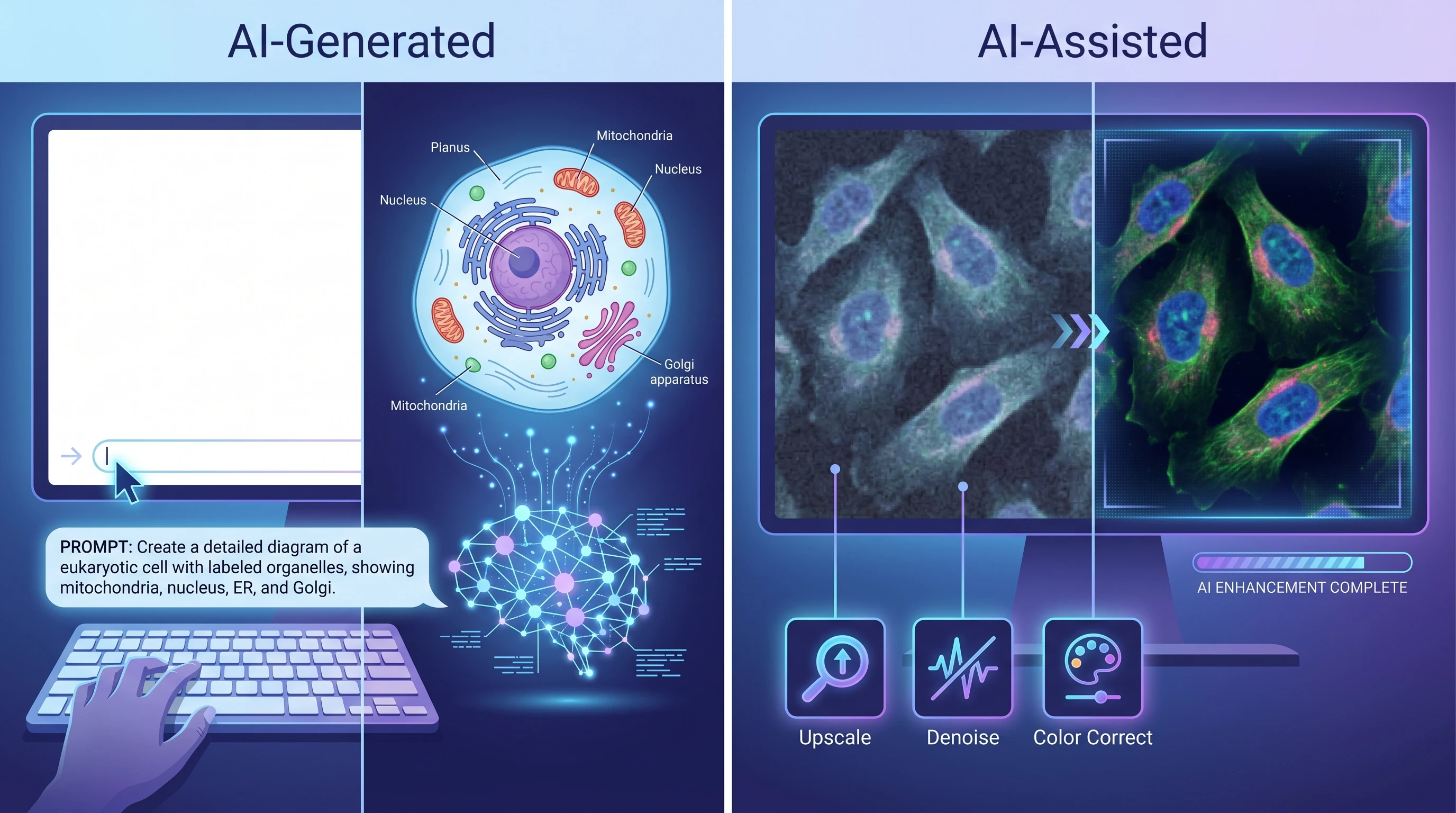
AI-Generated vs AI-Assisted: left shows blank canvas + prompt yielding complete figure (generated); right shows existing microscopy image being enhanced (assisted) (Figure generated with SciFig)
AI-generated figures are illustrations produced by a generative model based on a prompt or description, where no pre-existing image was the direct input. A researcher types "show a CRISPR-Cas9 complex cutting a double-stranded DNA molecule" into a text-to-figure tool and receives a complete illustration. The AI created the visual content — it did not merely process something that already existed.
AI-assisted figures involve using AI tooling to enhance, reformat, clean up, or recompose an existing image. Examples include using AI-powered tools to upscale resolution, remove background noise from microscopy images, adjust white balance, or reorganize panel layouts. The content — what the scientific figure shows — originated with the researcher; the AI only helped with presentation or technical quality.
This distinction matters because journals scrutinize these categories differently. AI assistance for non-substantive technical improvement is broadly tolerated or accepted, often with no disclosure requirement beyond a methods note. AI generation of scientific content from scratch is where requirements around disclosure, accuracy, and appropriate use become more stringent.
A related distinction: data visualization (charts, graphs, plots) is a third category that falls mostly outside AI-figure concerns. If your bar graph is produced by R or Python from real experimental data, the fact that a language model helped you write the plotting code is generally immaterial. The scientific figure represents actual data, not AI-generated imagery.
The policies below focus primarily on conceptual and illustrative figures — diagrams, schematics, pathway illustrations, experimental design overviews — rather than data plots.
Nature Publishing Group Policies
Nature Publishing Group (NPG), which publishes Nature, Nature Medicine, Nature Methods, Nature Communications, and dozens of other journals, established AI content policies in early 2023 and replaced them wholesale during 2026. If you are working from guidance written before that — including earlier versions of this page — the sentence you remember, that Springer Nature journals are "unable to permit" AI-generated images, is no longer on the policy page, and neither are the three exceptions that used to accompany it. What replaced it is not a relaxation so much as a different axis: use is now judged by risk level rather than by tool type, and the obligations attach to accountability and disclosure.
Nature policy guide
The operative sentence in Springer Nature's editorial policy now reads:
"Use of AI is governed according to risk level, not by tool type. The same framework applies across all roles: authors, reviewers and editors."
The core requirements across NPG titles are:
1. There is no blanket ban on AI-generated figures — and no blanket permission. Use is sorted into three tiers: Green (assistive, "without influencing scientific, scholarly or evaluative judgement"), Amber (may influence "interpretation, framing, emphasis, or evaluative judgement, but remains under human control"), and Red (not permitted). A schematic is not assigned a tier by the software that drew it; it is assigned by what the AI contributed and whether you can account for it.
2. Only one image-specific line sits in the Red tier: "Creating photorealistic images (deepfakes)." The other Red entries that can catch a figure are about substance rather than medium — "Fabricating data, citations or results," and presenting AI-generated conclusions "as human-derived." A pathway diagram is neither, which is why it is not banned outright; a simulated micrograph presented as data is both, which is why it never was and never will be acceptable.
3. Accountability is the actual test, and it does not transfer. The first of four core expectations is stated flatly: "Human accountability is non-transferable — Accountability for scholarly content, evaluation, and editorial decisions cannot be delegated to AI systems." Green-tier use is characterised as "likely to be reversible and verifiable," which is a workable self-test for a figure: can you show where each element came from, and change any of them? A flattened one-shot render fails that test; an editable vector file you reviewed element by element passes it.
4. AI cannot be listed as an author. Consistent across all publishers, and now explicitly in the Red tier ("Assigning authorship or accountability to AI systems or tools"). AI tools do not meet authorship criteria — they cannot take responsibility for the work, respond to correspondence, or provide consent.
5. The text side got stricter, not looser. The old policy said in as many words that "AI assisted copy editing" did not need to be declared. That sentence is gone. Language polishing now sits in Green, where "Disclosure enhances trust and transparency," and "extensive copy editing or writing support" has moved up to Amber, which is "permitted with human oversight, verification, and transparency through disclosure." If you learned the permissive version, you learned a rule that no longer exists.
Two practical notes. The Portfolio-level policy states principles; the journal-level author guidance is where the mechanics live, and it is more specific — LLM use "should be properly documented in the Methods section (and if a Methods section is not available, in a suitable alternative part) of the manuscript." And the policy page carries no version number and no effective date, while stating that these policies "will be reviewed periodically." Read the current page before you submit rather than relying on any summary, including this one.
Science (AAAS) Policies
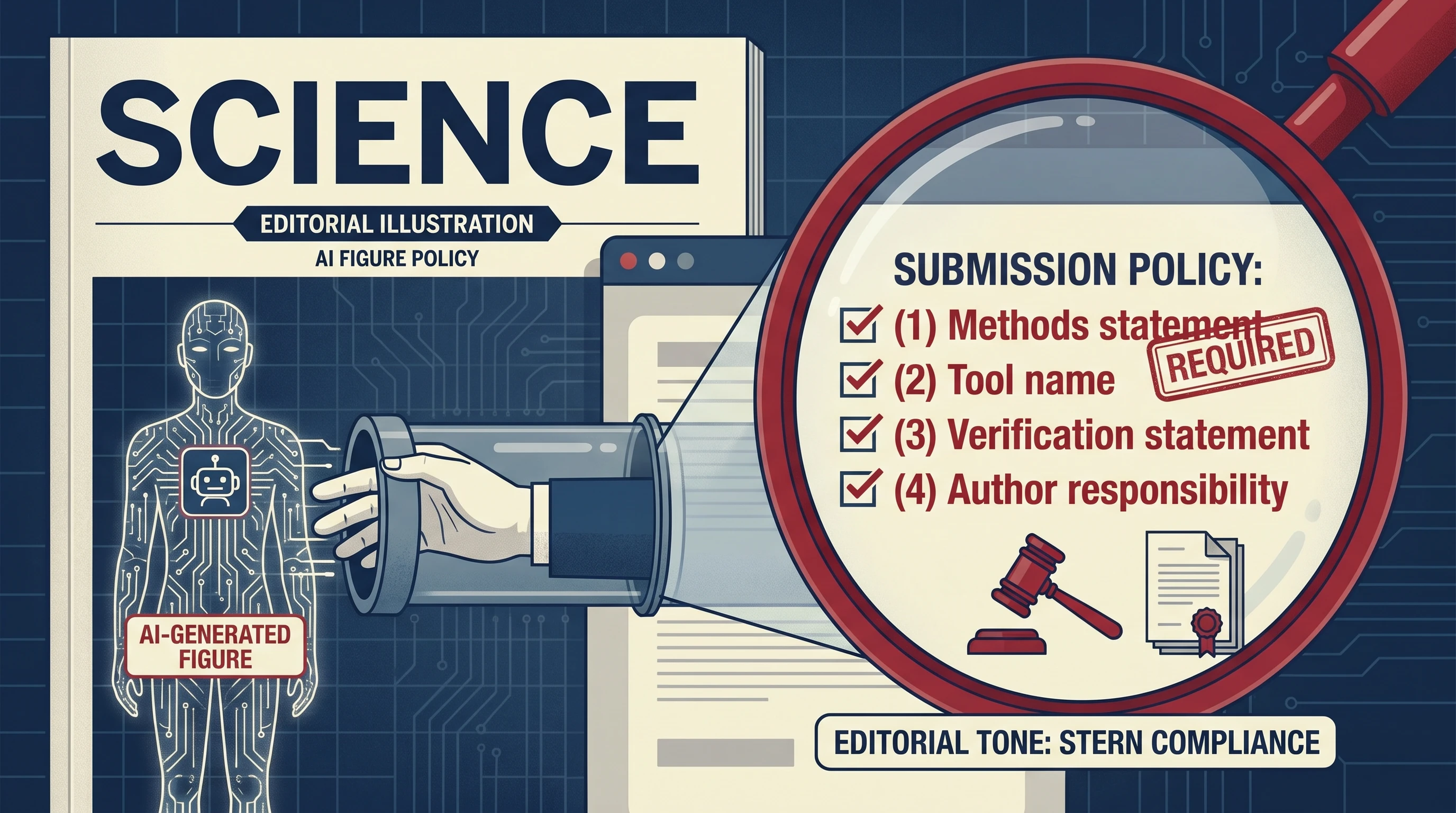
Science magazine and its family of journals (Science Advances, Science Translational Medicine, Science Immunology) require explicit editorial permission before any AI-generated image can appear — a default of "no" that can be lifted case by case, rather than a disclosure-based default of "yes."
"AI-generated images and other multimedia are not permitted in the Science journals without explicit permission from the editors."
What this means in practice:
Permission comes first, disclosure second. You cannot simply generate an illustrative figure, disclose it, and submit. Exceptions "may be granted in certain situations — e.g., for images and/or videos in manuscripts specifically about AI and/or machine learning," are "evaluated on a case-by-case basis," and "should be disclosed at the time of submission."
Where AI use is disclosed is unusually specific. Authors using AI-assisted technologies "as components of their research study or as aids in the writing or presentation of the manuscript should note this in the cover letter and in the methods section or acknowledgments section." The cover letter requirement is easy to miss and is not how most journals handle it.
AI cannot be an author or a cited source. AI-assisted technologies "do not meet the Science journals' criteria for authorship," and sources cited in Science content may not be authored or co-authored by AI tools.
There is a stated consequence. "Editors may decline to move forward with manuscripts if AI is used inappropriately."
Reviewers are restricted too. Reviewers may not enter any part of a manuscript into an LLM, as that would breach confidentiality, though they may use AI to revise their own writing if the system does not train on inputs and the use is declared.
Science also notes that its "position on AI-generated multimedia may change with the evolution of copyright law and industry standards" — again signalling that copyright, not accuracy, is the governing concern.
Cell Press Policies
Cell Press, the Elsevier-owned publisher of Cell, Molecular Cell, Cell Reports, and related journals, operates under both Elsevier's broader AI policy framework and Cell Press-specific editorial guidelines.
Warning
This section could not be re-verified for the August 2026 update. cell.com blocks automated access, so unlike the Nature and Science sections above — which quote policy text read directly from the publishers' current pages — the description below has not been checked against Cell Press's live guidelines. One of the two publishers we were able to re-check had rewritten its policy end to end since the last version of this page, so treat the following as unverified and read Cell Press's own policy page before relying on it. Cell Press publishes its terms under "Generative AI and figures, images, and artwork" in its journal policies.
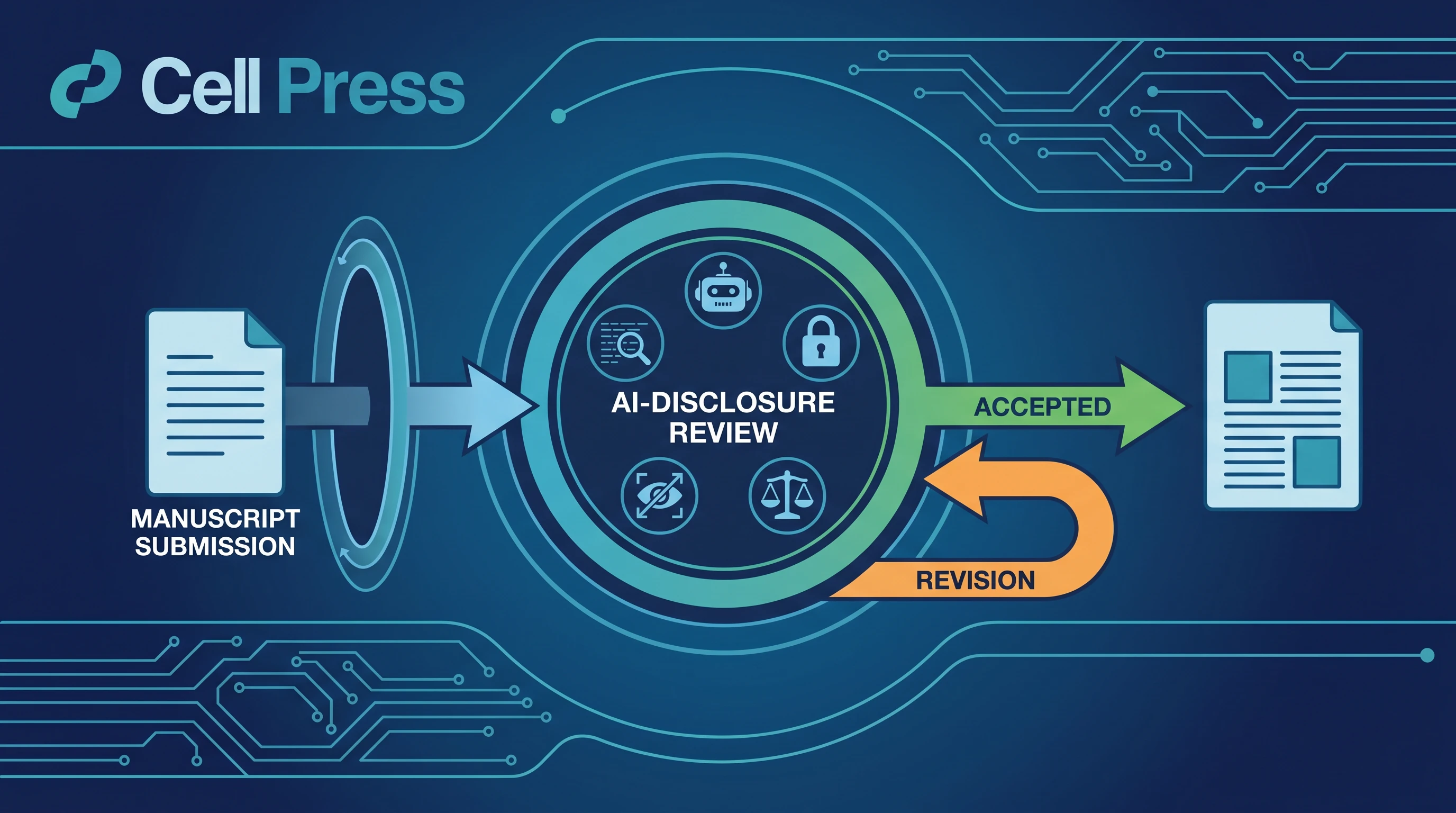
Cell Press editorial workflow: manuscript with AI figures → AI-disclosure review checkpoint with 5 criteria → accepted (green) or revision needed (orange) (Figure generated with SciFig)
The current Cell Press position reflects Elsevier's three-part framework:
Transparency. Authors must declare AI tool use in a dedicated section of the manuscript, typically following the acknowledgments. The declaration should specify the tool, the version or access date, and the purpose of use.
Responsibility. Authors remain fully accountable for the content of AI-generated or AI-assisted figures. Cell Press journals expect authors to be able to explain and defend any figure regardless of how it was produced.
No AI authorship. Consistent with industry norms, Cell Press journals do not permit AI tools to be listed as authors or co-authors.
Cell Press journals apply particular scrutiny to image integrity. The journals use automated image analysis tools to screen submissions for inappropriate manipulation. While these tools were developed with traditional image fraud in mind, they can also flag inconsistencies introduced by generative AI. Authors should ensure that AI-generated figures do not inadvertently create visual artifacts that trigger integrity screening.
Because this section is unverified, we are not stating whether Cell-family journals currently accept AI-generated illustrative figures. Check "Generative AI and figures, images, and artwork" in the journal's policies before assuming either answer.
See AI Scientific Figure Generation in Action
Watch how researchers create publication-ready scientific figures from text descriptions.
Across Nature Publishing Group, Science, and eLife, the policies diverge sharply on images while converging on text. Assuming a policy transfers between publishers is the most expensive mistake available in this area.
Journal policy comparison
Policy Element
Nature Publishing Group
Science (AAAS)
eLife
AI-generated illustrative figures
No blanket ban — judged by risk tier, disclosure expected
Copyright + industry standards; position may change
— (permissive)
Disclosure location
Methods section, per journal-level guidance
Cover letter and methods or acknowledgments
Materials and Methods
AI authorship
Not permitted
Not permitted
Not permitted
Stated consequence
—
Editors may decline to proceed
— (general integrity policies apply)
Generative AI for manuscript text
Permitted with disclosure and human accountability
Permitted with disclosure
Permitted; describe in Materials and Methods
Hard ban on one specific image
—
—
Striking image (CC-BY licensing)
The spread here is the point. The same pathway schematic that needs only one sentence in Materials and Methods at eLife needs a documented disclosure and demonstrable human oversight at a Nature-family journal, and editorial permission before submission at Science. If you may transfer a manuscript between journals, prepare for the strictest policy in your target set — for eLife specifically, see eLife AI policy.
The real pattern is not "disclosure is the universal norm." It is that the three publishers restrict images through different mechanisms, and those mechanisms are converging on one question. Science still gates on permission and cites copyright and evolving industry standards. eLife's one hard ban is a licensing problem — it attaches precisely to the image it must redistribute under CC-BY. Springer Nature has moved furthest, from a copyright-based prohibition to a test of whether the work is "reversible and verifiable" and whether accountability stayed human. Different levers, same underlying question: can you account for the image and stand behind every element of it? For a practical comparison of AI-native vs. traditional scientific illustration tools, see the 2026 illustration tools comparison.
Smaller society journals and specialty publications are less standardized. Some have explicit AI policies, many do not. When a policy is absent, the default expectation at most journals is that images represent what they purport to represent — which means using AI to create content presented as experimental evidence remains problematic regardless of whether a policy explicitly addresses it.
The Red Line — What Is Still Banned
Publisher positions on illustrative figures vary widely, as the table above shows. But several categories of AI use remain universally prohibited, at permissive and restrictive journals alike.
Fabrication of experimental evidence. Using a generative AI tool to create an image — a gel band, a microscopy field, a histological section — that is then presented as an actual experimental result is scientific fraud. It does not matter that the image was AI-generated rather than hand-drawn; the deception is identical. This is not a gray area. The retraction and potential misconduct consequences are severe.
Undisclosed AI use. Using an AI tool to generate figures and not disclosing it is a policy violation at every major publisher that has issued AI guidelines. Even if the scientific figures are scientifically accurate, failing to disclose violates the transparency requirements that underpin research integrity.
Misleading data visualization. Using AI (or any tool) to create visual representations that misrepresent statistical results, exaggerate effect sizes, or present data in ways that lead to incorrect conclusions is prohibited. This applies whether the distortion is intentional or inadvertent — researchers are responsible for ensuring their visualizations accurately represent their data.
Enhancement of experimental images that changes scientific conclusions. Noise reduction, contrast adjustment, and resolution enhancement of experimental images are acceptable when applied uniformly and disclosed. Using AI to selectively enhance specific features, remove inconvenient artifacts, or make ambiguous results appear clearer than they are crosses into manipulation.
Generation of figures for fraudulent purposes. Using AI to generate figures for fabricated studies, duplicate publications, or papers where the described experiments were not conducted is covered by existing misconduct frameworks and is treated identically to traditional fabrication.
The common thread in this list is deception and misrepresentation. But note the distinction from the section above: these are the prohibitions every publisher shares. Whether a perfectly honest, accurate, disclosed illustrative figure is allowed at all is a separate question, and there the publishers genuinely disagree — permitted with a disclosure sentence at eLife, allowed at Springer Nature only where accountability stays demonstrably human and the use is declared, and gated behind editorial permission at Science.
How to Cite AI Tools in Your Paper
Getting the disclosure right is as important as using the tools honestly. Here are practical templates for the two most common locations: the Methods section and the Acknowledgments section.
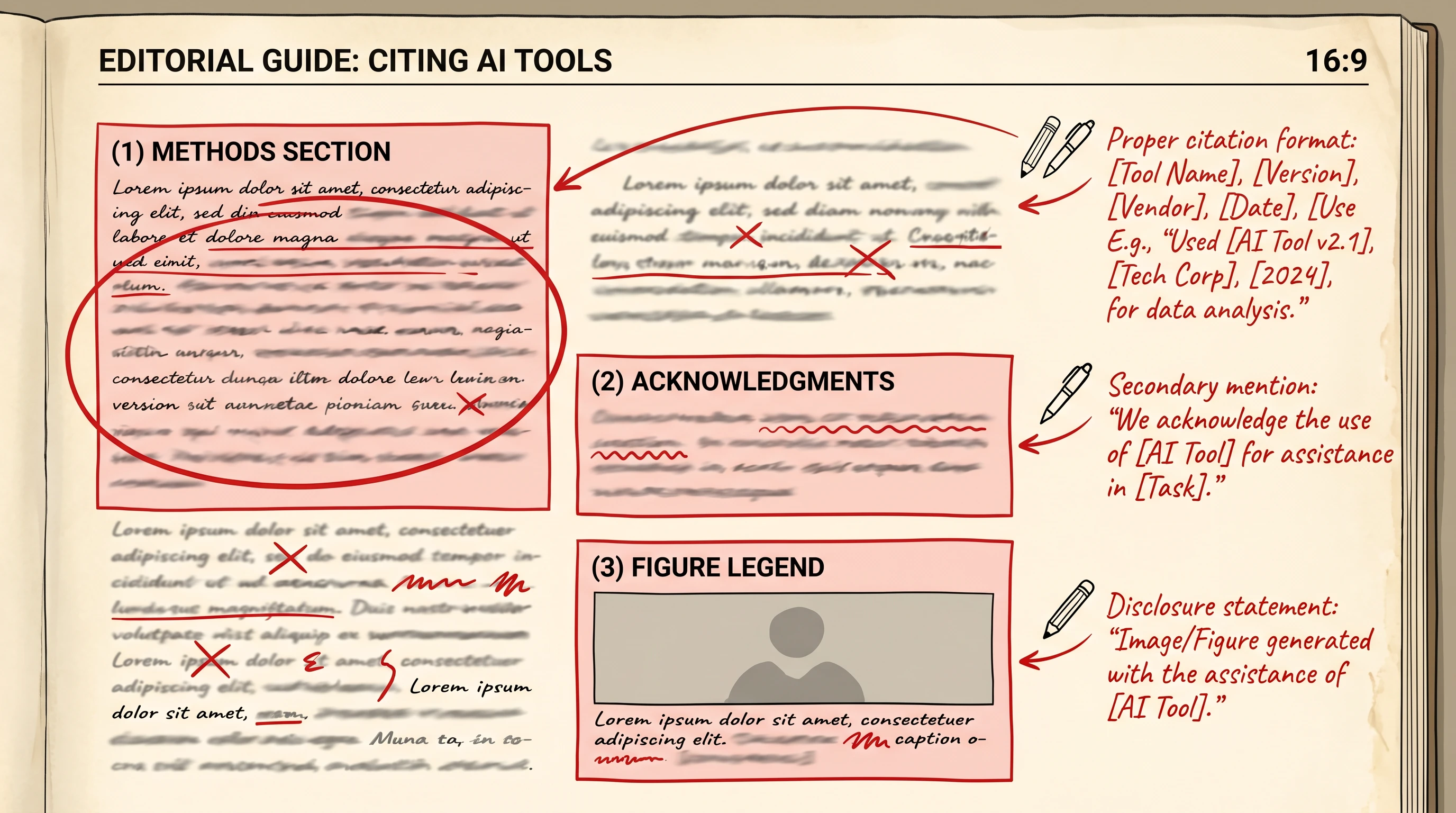
Manuscript guide showing 3 highlighted sections for AI tool citation: Methods (full citation), Acknowledgments (secondary mention), Figure legend (disclosure) (Figure generated with SciFig)
Methods Section — General Template
AI-generated figures in this manuscript were produced using [Tool Name, version/access date]. Figures [X, Y] are AI-generated conceptual illustrations. All AI-generated figures were reviewed by the authors for scientific accuracy and are intended to illustrate [mechanism/process/experimental design], not to represent experimental data.
Methods Section — Specific Example
Figure 3 was created using SciFig (scifig.ai). The authors reviewed and edited all elements and take responsibility for the accuracy of the content shown. The figure is illustrative and does not represent experimental data.
Acknowledgments Section — Short Form
AI tools: [Tool Name] was used for figure generation. [Tool Name] was not involved in study design, data collection, analysis, or interpretation, and does not qualify for authorship.
Acknowledgments Section — Elsevier/Cell Press Format
Declaration of generative AI and AI-assisted technologies in the writing process: During the preparation of this work, the authors used [Tool Name] for figure generation. After using this tool/service, the authors reviewed and edited the content as needed and take full responsibility for the content of the publication.
A few practical notes on citations:
Never list the AI tool as an author. Use it in the methods or acknowledgments as a tool, not a contributor.
Include a version number only if the tool publishes one. Desktop and API tools usually do; browser-based tools usually do not, and inventing one is worse than omitting it. Where there is no published version, the tool name and its address are what the disclosure needs — SciFig has no user-facing version number, which is why the example above carries neither a version nor an access date.
Be specific about which figures were AI-generated. "Figures 1A and 3C were AI-generated" is better than a vague general statement.
State what the scientific figures represent — clarifying that they are conceptual illustrations rather than experimental evidence removes ambiguity.
Check journal-specific format requirements. Some journals have standardized the AI disclosure statement format; use their template if one is provided.
Create Scientific Figures Now
Describe your scientific figure in natural language — get publication-ready illustrations in minutes.
Journal AI policies are actively evolving. The positions described in this guide reflect publicly available guidelines as of early 2026. Before submitting any manuscript, verify the current AI policy on the specific journal's author guidelines page — do not rely on this or any secondary source as a substitute for the journal's own documentation. When in doubt, contact the editorial office directly.
Frequently Asked Questions
It depends entirely on the journal, and the answer is not uniform. For conceptual and illustrative figures — pathway diagrams, experimental design schematics — eLife permits them with disclosure in Materials and Methods, Science requires explicit editorial permission first, and Springer Nature journals judge them by risk tier, expecting disclosure and demonstrably human accountability rather than applying a blanket ban. Check your target journal before you start. For figures presented as experimental evidence (microscopy images, gel results, histology), generative AI may not be used to create the content anywhere. Using AI to illustrate a mechanism you have established through experiments is acceptable where the journal permits AI images at all; using AI to simulate what an experiment would show never is.
Failure to disclose AI use is a policy violation at journals that require disclosure. Consequences range from requiring a correction (if the scientific figures are otherwise legitimate) to retraction if the non-disclosure is considered part of a broader pattern of misrepresentation. In cases of honest omission where the scientific figures are accurate and properly produced, journals typically allow authors to add a disclosure statement via correction. The risk is not worth taking — disclose proactively.
This depends on the journal and the nature of the enhancement. Non-substantive technical improvements — resolution upscaling of a conceptual illustration, background cleanup — are generally acceptable with a brief methods note rather than a full AI-use declaration. However, if AI was used on experimental image data, disclosure is expected regardless of the extent of processing. When uncertain, err on the side of disclosing.
Reviewers apply the same scientific accuracy standard to AI-generated figures that they apply to all figures: does this accurately represent the biology, chemistry, or mechanism being described? The AI origin of a scientific figure does not provide any special protection from critique, nor does it inherently disadvantage a figure in review. A disclosed, accurate AI-generated illustration is evaluated on whether it communicates the science correctly — just like any other figure.
Fewer than there were. Science journals still do not permit AI-generated images "without explicit permission from the editors" — a default of no, liftable case by case. Springer Nature, which used to state it was "unable to permit" them, replaced that prohibition during 2026 with a risk-tier framework: the only image-specific ban left is on "Creating photorealistic images (deepfakes)," while everything else turns on disclosure and on accountability remaining human. Two things follow. A blanket ban is no longer the industry direction — but "no blanket ban" is not "no rules," and a policy summary older than a few months may be describing a policy that no longer exists, including at journals not covered here.
Sources
Nature Portfolio AI editorial policy — Springer Nature's risk-assessment framework, its three tiers, and the core expectations that apply to authors
Science journals editorial policies — the "Artificial intelligence (AI)" section, covering AI-generated images, disclosure locations, and reviewer restrictions
Boundaries. The Nature Portfolio and Science statements quoted above come from the publishers' own policy pages. The Cell Press section could not be verified because cell.com blocks automated access, and is flagged as unverified in place. Publisher AI policies are changing quickly — confirm the current text on the journal's own author guidelines before submitting. See our editorial standards for how these guides are researched and corrected.
Recommended next
Related scientific figure resources
Go deeper with the most relevant SciFig pages for this article.